//
Showing posts with label NLP. Show all posts

Monday, July 31, 2023

Basic Usage of ChatGPT API


Unlocking the Power of ChatGPT through the OpenAI API

ChatGPT has captured the world's attention with its ability to understand natural language and generate human-like responses. While the conversational interface is impressive, the real magic lies in the underlying AI models developed by OpenAI. In this post, we'll explore how you can access these models directly through the OpenAI API to build powerful natural language applications.

Capabilities of the ChatGPT API

The ChatGPT API allows you to have conversational exchanges with AI assistants. You provide a conversation history and the API returns an assistant's response.

Conversations are formatted with system, user, and assistant messages:

  • System - Sets assistant's personality/behavior
  • User - User requests and comments
  • Assistant - AI-generated responses

For example:


messages = [
  {"role": "system", "content": "You are a helpful assistant"},
  {"role": "user", "content": "What is the weather forecast today?"},
  {"role": "assistant", "content": "The weather today is sunny with a high of 70F."} 
]

The API can be used for a wide range of applications like answering questions, language translation, text summarization, and more!

Chatting with the API

Here is some sample Python code to call the ChatGPT API:


import openai

response = openai.ChatCompletion.create(
  model="gpt-3.5-turbo",
  messages=[
    {"role": "system", "content": "You are a helpful assistant."},
    {"role": "user", "content": "What is the capital of France?"}
  ]  
)

print(response["choices"][0]["message"]["content"])

We provide a system message to set the assistant's behavior. The user message asks a question.

The API response contains the assistant's answer, which we can extract and print.

Some helpful functions


def get_completion_from_messages(messages, 
                                 model="gpt-3.5-turbo", 
                                 temperature=0, 
                                 max_tokens=500):
    response = openai.ChatCompletion.create(
        model=model,
        messages=messages,
        temperature=temperature, # this is the degree of randomness of the model's output
        max_tokens=max_tokens, # the maximum number of tokens the model can ouptut 
    )
    return response.choices[0].message["content"]

def get_completion_and_token_count(messages, 
                                   model="gpt-3.5-turbo", 
                                   temperature=0, 
                                   max_tokens=500):
    
    response = openai.ChatCompletion.create(
        model=model,
        messages=messages,
        temperature=temperature, 
        max_tokens=max_tokens,
    )
    
    content = response.choices[0].message["content"]
    
    token_dict = {
'prompt_tokens':response['usage']['prompt_tokens'],
'completion_tokens':response['usage']['completion_tokens'],
'total_tokens':response['usage']['total_tokens'],
    }

    return content, token_dict

Function Calling

The ChatGPT API also supports function calling. This allows the assistant to return structured data by calling functions you define.

For example:


import openai
import json

def get_weather(location):
  # Call weather API
  return {"temp": "70F"} 

response = openai.ChatCompletion.create(
  model="gpt-3.5-turbo",
  messages=[
    {"role": "user", "content": "What's the weather in Paris?"}
  ],
  functions=[{
    "name": "get_weather",
    "parameters": {"location": "string"} 
  }]
)

if response["choices"][0]["message"].get("function_call"):
  func_name = response["choices"][0]["message"]["function_call"]["name"] 
  args = json.loads(response["choices"][0]["message"]["function_call"]["arguments"])
  weather = get_weather(location=args["location"])
  
  print(weather) # Prints weather data

Here we defined a `get_weather` function. The API response contains JSON to call this function which we execute to get structured weather data.

The ChatGPT API opens up many possibilities for building advanced applications! With proper prompting and techniques, you can harness these models in creative ways.

Friday, March 6, 2020

ON-LSTM

Summary:

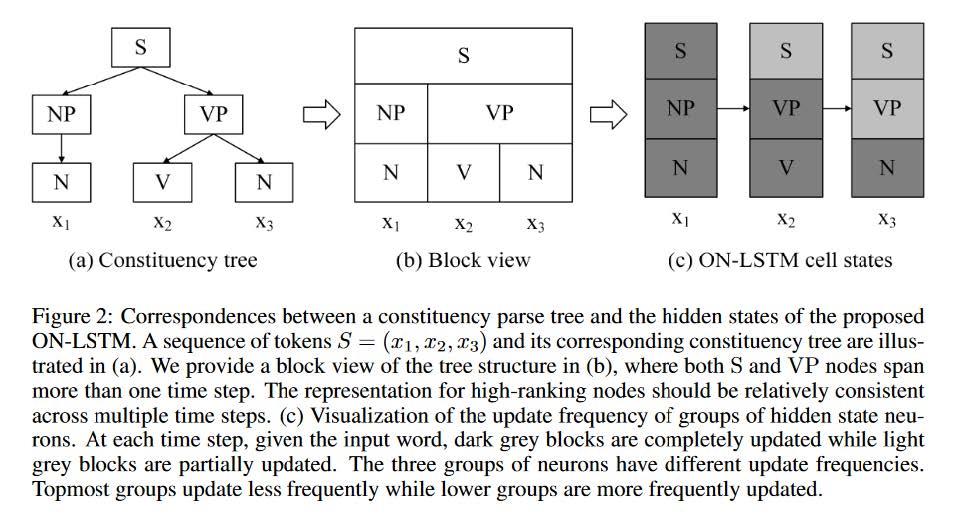
  • This paper introduces a variant of LSTM which can unsupervisely learn latent sentences structures(?), further benefiting grammar related tasks(unsupervised constituency parsing, target syntactic evaluation, etc.)
  • It introduces two additional gates: Master Forget Gate and Master Input Gate controlling updating mechanism of LSTM
  • It divides hidden state into an unequal place: higher location(those with bigger indexes) are used for storing history information and harder to erase, lower locations are for newer information.  The division is not hard(by binary gates I mean), but by softmax gates for back propagating purpose.

Overall Designing Principles


  • Languages are hierarchical and structured.  
And the author wants to incorporate this prior to the model. For each time step t. Some parts of the hidden states should be preserved(correspond to top layers in the hierarchy, like the S which stands for subject in the figure. This of course should be kept further.)

To this end, Master Forget Gate and Master Input Gate controlling updating mechanism of LSTM have been proposed.
We wan to define $d^f_t$ and $d_t^i$ which represent the split points for
(0,...,0, 1,...,1)   (idealized Master Forget Gate)and
(1, ..., 1, 0, ..,0, 0) (idealized Master Input Gate)respectively.

Consider two different cases:
Case I: $d^f_t \le d_t^i$, input level $d_t^i$ is greater or equal to forget(history) level $d^f_t$ .
0  0  0  1  1  1  1  1 $d^f_t=4$
1  1  1  1  0  0  0  0  $d_t^i=4$
N N N C O O O O
Where N means update with new element, C means standard LSTM update meachanism, O stands for keep original information.

Case II: $d^f_t \gt d_t^i$, input level $d_t^i$ is less than forget(history) level $d^f_t$ .
0  0  0  0  1  1  1  1 $d^f_t=5$
1  1  1  0  0  0  0  0 $d_t^i=3$
N N N X O O O O

Where X means putting 0 in that position.

But outputing binary is differentiable in neural nets, so author chooses softmaxen-ed operations instead.
Define operation cumax :

def cumsoftmax(x, dim=-1):
    return torch.cumsum(F.softmax(x, dim=dim), dim=dim)

Define Master Forget Gate and Master Input Gate as:
$$\begin{array}{l}
\tilde{f}_{t}=\overrightarrow{\mathrm{cumsum}}\left(\operatorname{softmax}\left(W_{\dot{f}} x_{t}+U_{\tilde{f}} h_{t-1}+b_{\tilde{f}}\right)\right) \\
\tilde{i}_{t}=\overleftarrow{\mathrm{cumsum}}\left(\operatorname{softmax}\left(W_{\tilde{i}} x_{t}+U_{\tilde{i}} h_{t-1}+b_{\tilde{i}}\right)\right) =1-
\overrightarrow{\mathrm{cumsum}}\left(\operatorname{softmax}\left(W_{\tilde{i}} x_{t}+U_{\tilde{i}} h_{t-1}+b_{\tilde{i}}\right)\right)
\end{array}$$

Comparison to LSTM

Note:
  • Blue stands for Gate Mechanism (LSTM)
  • Red stands for content updating mechanism (LSTM)
  • Fuchsia stands for ON-LSTM introduced Gate Mechanism (ON-LSTM)
  • Green stands for ON-LSTM impacted Gates (ON-LSTM)
  • This yellowish #e69138 color stands for impacted content updating mechanism (ON-LSTM)

LSTM:


Forget gate: controls what is kept vs forgotten, from previous cell state

$\boldsymbol{f}^{(t)}=\sigma \left(\boldsymbol{W}_{f} \boldsymbol{h}^{(t-1)}+\boldsymbol{U}_{f} \boldsymbol{x}^{(t)}+\boldsymbol{b}_{f}\right)$

Input gate: controls what parts of the new cell content are written to cell

$\boldsymbol{i}^{(t)}=\sigma \left(\boldsymbol{W}_{i} \boldsymbol{h}^{(t-1)}+\boldsymbol{U}_{i} \boldsymbol{x}^{(t)}+\boldsymbol{b}_{i}\right)$

Output gate: controls what parts of cell are output to hidden state

$\boldsymbol{o}^{(t)}=\sigma \left(\boldsymbol{W}_{o} \boldsymbol{h}^{(t-1)}+\boldsymbol{U}_{o} \boldsymbol{x}^{(t)}+\boldsymbol{b}_{o}\right)$

New cell content: this is the new content to be written to the cell

$\tilde{\boldsymbol{c}}^{(t)}=\tanh \left(\boldsymbol{W}_{c} \boldsymbol{h}^{(t-1)}+\boldsymbol{U}_{c} \boldsymbol{x}^{(t)}+\boldsymbol{b}_{c}\right)$

Cell state: erase (“forget”) some content from last cell state, and write (“input”) some new cell content

$\boldsymbol{c}^{(t)}=\boldsymbol{f}^{(t)} \circ \boldsymbol{c}^{(t-1)}+\boldsymbol{i}^{(t)} \circ \tilde{\boldsymbol{c}}^{(t)}$

Hidden state: read (“output”) some content from the cell

$\boldsymbol{h}^{(t)}=\boldsymbol{o}^{(t)} \circ \tanh \boldsymbol{c}^{(t)}$


LSTM,  Source: https://kexue.fm/archives/6621

ON-LSTM

Intersection(Optional): Hadamard Product between Master Forget Gate and Master Input Gate
$\omega_t= \tilde{f_t} \cdot \tilde{i_t}$

Master Forget gate: Ordered Forget Gate Control Mechanism 

$\tilde{f}_{t}=\overrightarrow{\mathrm{cumsum}}\left(\operatorname{softmax}\left(W_{\dot{f}} x_{t}+U_{\tilde{f}} h_{t-1}+b_{\tilde{f}}\right)\right) $

Forget gate: controls what is kept vs forgotten, from previous cell state

$\hat{f}_{t}=f_{t} \circ \omega_{t}+\left(\tilde{f}_{t}-\omega_{t}\right)=\tilde{f}_{t} \circ\left(f_{t} \circ \tilde{i}_{t}+1-\tilde{i}_{t}\right)$


Master Input gate: Ordered Input Gate Control Mechanism 

$\tilde{i}_{t}=\overleftarrow{\mathrm{cumsum}}\left(\operatorname{softmax}\left(W_{\tilde{i}} x_{t}+U_{\tilde{i}} h_{t-1}+b_{\tilde{i}}\right)\right) =1-
\overrightarrow{\mathrm{cumsum}}\left(\operatorname{softmax}\left(W_{\tilde{i}} x_{t}+U_{\tilde{i}} h_{t-1}+b_{\tilde{i}}\right)\right)$

Input gate: controls what parts of the new cell content are written to cell

$\hat{i}_{t}=i_{t} \circ \omega_{t}+\left(\tilde{i}_{t}-\omega_{t}\right)=\tilde{i}_{t} \circ\left(i_{t} \circ \tilde{f}_{t}+1-\tilde{f}_{t}\right)$

Output gate: controls what parts of cell are output to hidden state

$\boldsymbol{o}^{(t)}=\sigma \left(\boldsymbol{W}_{o} \boldsymbol{h}^{(t-1)}+\boldsymbol{U}_{o} \boldsymbol{x}^{(t)}+\boldsymbol{b}_{o}\right)$

New cell content: this is the new content to be written to the cell

$\tilde{\boldsymbol{c}}^{(t)}=\tanh \left(\boldsymbol{W}_{c} \boldsymbol{h}^{(t-1)}+\boldsymbol{U}_{c} \boldsymbol{x}^{(t)}+\boldsymbol{b}_{c}\right)$

Cell state: erase (“forget”) some content from last cell state, and write (“input”) some new cell content

$c_{t}=\hat{f}_{t} \circ c_{t-1}+\hat{i}_{t} \circ \hat{c}_{t}$

Hidden state: read (“output”) some content from the cell

$\boldsymbol{h}^{(t)}=\boldsymbol{o}^{(t)} \circ \tanh \boldsymbol{c}^{(t)}$

ON-LSTM, Source: https://kexue.fm/archives/6621/comment-page-1

What's Next? 

  • Is "cumax"(cusum + softmax) really necessary?
From what I have observed., in reality the forget and input gates are not in the (0,0,0,1,1,1) or (1,1,1,0,0,0) regime. Take one for example:
[0.3182306 , 0.4296763 , 0.5659539 , 0.6581644 , 0.8738386 ,
         0.94163144, 0.9522468 , 0.95804715, 0.960161  , 0.96124136,
         0.96252906, 0.963744  , 0.964411  , 0.96599156, 0.9674326 ,
         0.9684573 , 0.96898276, 0.9697275 , 0.97011393, 0.9703722 ,
         0.9713492 , 0.9736657 , 0.97405773, 0.9745897 , 0.9753741 ,
         0.97613144, 0.9766177 , 0.97877145, 0.98247737, 0.9835741 ,
         0.9863124 , 0.9878812 , 0.9899598 , 0.9946286 , 0.99710023,
         0.99824625, 0.9990951 , 0.9997795 , 0.99986076, 1.0000001 ]
This is not idealized version of gates. Too many of "middle states", limiting the ordering ability of ON-LSTM. It's possible to use softmax to assign to splitting point, but that leads to non-differentiability.

  • Is the hidden states in LSTM ordered?

Friday, October 25, 2019

Fusion of Detected Objects in Text for Visual Question Answering

Models:

B2T2: Bounding Boxes in Text Transformer 

Concepts:

Late fusion: Text and image that are integrated late
Early fusion: The processing of one be conditioned on the analysis of the other 

Data:= $(I , B, T, I)$


  • $I$ is an image
  • $B=[b_1, b_2, ..., b_m ]$ a list of bounding boxes referring to regions of $I$, where each $b_i $ is identified by the lower left corner, height and width
  • $T=[t_1, ..., t_n]$ is a passage of tokenized text (some tokens are not natural language but references to $B$)
  • $l$ is a numeric class label in $\{ 0, 1\}$


B2T2:=

model the class distribution as:

$$p(l | T, I , B, R)= \frac{e^{\phi (E'(T, I, B, R))*a_l + b_l}}
{\sum_{l'}  e^{\phi (E'(T, I, B, R))*a_{l'} + b_{l'}} }
$$

$$
E'(T, I, B, R)= E(T) + \sum_{i=1}^m R_i [M \Phi(crop(I, b_i)) + \pi (b_i)]^T
$$

where $M$ is a learnt matrix, $\Phi$ can be a resnet, $\pi(b_i)$ denotes the embedding of $b_i$'s shape and position information in $R^d$